
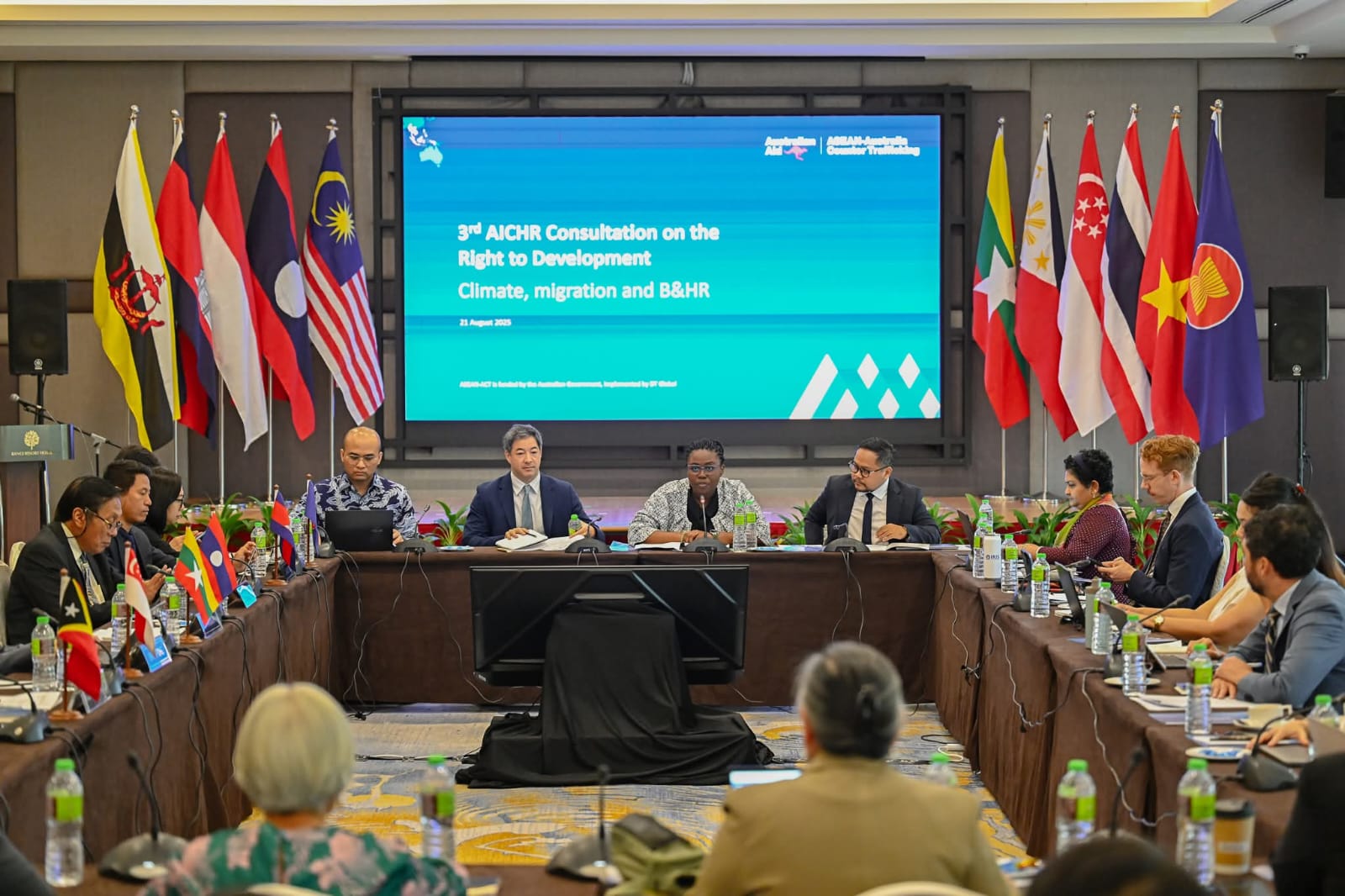
Selangor, Malaysia – 21 August 2025 – Climate change, forced displacement, unsafe migration, and irresponsible business practices are no longer abstract issues for ASEAN, they are urgent human rights challenges that demand collective action. This was the central message emerging from the 3rd AICHR Consultation on the Human Right to Development, which opened today in Selangor, Malaysia.
The two-day consultation, organized by the ASEAN Intergovernmental Commission on Human Rights (AICHR), brought together government representatives, civil society groups, academics, and international partners. Its focus: how to safeguard the region’s most vulnerable populations at the intersection of business and human rights, environmental change, and migration. The outcomes will shape AICHR’s common position as ASEAN moves towards the ASEAN Community Vision 2045.
The consultation comes at a pivotal time for Southeast Asia. The region is simultaneously a growth hub and one of the most climate-vulnerable in the world. Rapid economic development is being driven by industries such as palm oil, seafood, and mining, which connect ASEAN directly to global supply chains. Yet, this growth is also exposing deep structural problems.
“Southeast Asia serves as a key hub in the global supply chain for many essential commodities,” said Dr. Unang Mulkhan, speaking on behalf of the Foundation for International Human Rights Reporting Standards (FIHRRST) during Session 1: ASEAN Community Vision 2045 Outlook – Challenges and Opportunities on Climate Justice, Safe Migration, and Business and Human Rights.
He added a sharp warning: “While these industries bring enormous opportunities for development, they also generate significant human rights risks, from forced and child labour to unsafe working conditions and environmental degradation. ASEAN must confront these realities if it wishes to build a resilient and inclusive future.”
As an initial step toward creating resilient and inclusive businesses, Dr. Unang Mulkhan gave an example based on FIHRRST’s review of corporate Sustainability Reports from 2023, showing that a growing number of companies in Indonesia are beginning to disclose human rights protections. In his session, Dr. Mulkhan also proposed three practical steps for ASEAN governments and businesses:
1. Strengthen Regional Instruments – ASEAN can reinforce its regional frameworks by aligning corporate social responsibility (CSR) and human rights standards with international norms, ensuring these principles are embedded in economic integration and trade plans.
2. Protect Migrant and Vulnerable Workers – Safeguards under the ASEAN Consensus on Migrant Workers need stronger enforcement, supported by a regional data and monitoring system to track recruitment flows, employment contracts, and reported cases of abuse.
3. Promote Responsible Supply Chains – ASEAN can help micro, small, and medium enterprises (MSMEs) adopt ethical business practices by providing practical guidelines, simplified due diligence tools, and collaborative support from bodies such as AICHR and the ASEAN Economic Community (AEC). These measures would make it easier for MSMEs to implement responsible conduct while gaining better access to domestic and international markets.
From the three practical steps proposed for ASEAN governments and businesses, this process is expected to serve as a foundation for balancing economic growth with the protection of human rights. By strengthening regional instruments and safeguarding migrant and vulnerable workers, ASEAN can ensure that its development is not only profit-driven but also rooted in justice, sustainability, and inclusion for all its people.