
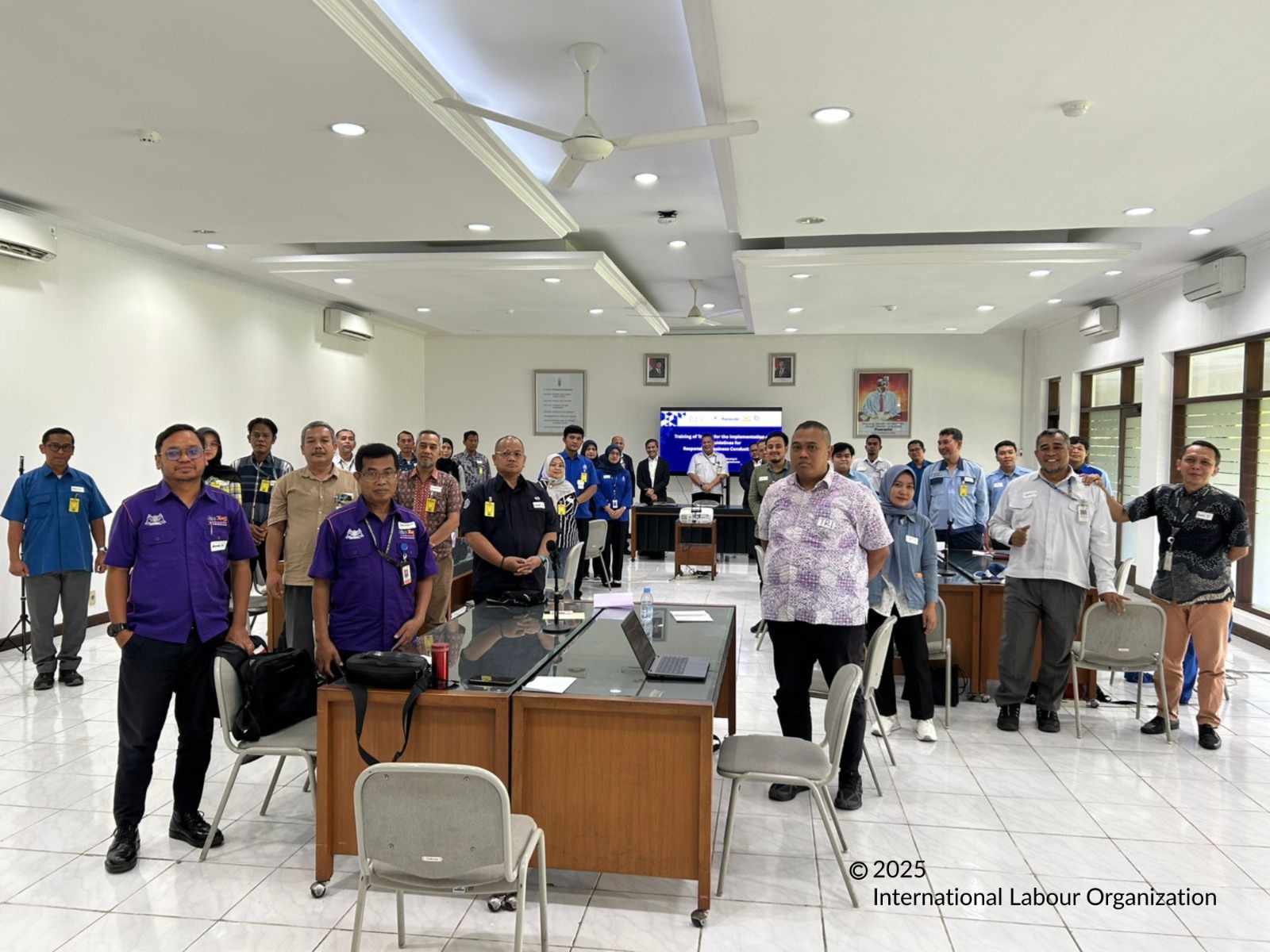
ILO and FIHRRST Conduct Human Rights Due Diligence Training for Trainers
At Panasonic Manufacturing Indonesia
The Foundation for International Human Rights Reporting Standards (FIHRRST), in partnership with the International Labour Organization (ILO), conducted a two-day training program from 1–2 July 2025 for Panasonic Manufacturing Indonesia in Pasar Rebo, East Jakarta. The training aimed to enhance understanding and implementation of the Guidelines for Responsible Business Conduct (RBC) within electronics companies. This session follows a previous training held with PT Panasonic Industrial Devices Batam on 7–8 May 2025.
The objectives of the workshop were to share international instruments related to responsible business conduct, including the ILO MNE Declaration, ILO Social Policy, ILO Fundamental Conventions, and Human Rights Due Diligence (HRDD), with relevant rights holders and stakeholders. In addition, the workshop aimed to equip company representatives to become internal trainers in implementing the Guidance Toolkit on RBC, while also improving their understanding and capacity to embed responsible business practices throughout their company’s operations.
The training covered key modules from the Guidance Toolkit for Responsible Business Conduct and Human Rights Due Diligence (HRDD), including:
Understanding Responsible Business Conduct (RBC) for SMEs in the Electronics Sector
Integrating Decent Work, Skills Development, and Lifelong Learning into RBC
Implementing Human Rights Due Diligence
Strengthening RBC for SMEs through Monitoring, Evaluation, and Continuous Improvement
To further equip participants to serve as internal trainers within their companies, the training also included a segment on active learning and adult education, emphasizing effective methods for knowledge transfer and facilitation tailored to adult learners.
The toolkit is structured around five HRDD steps: developing policies, identifying and assessing risks, integrating solutions, tracking performance, and communicating actions. This comprehensive approach equips companies to not only align with international standards but also foster a more responsible and sustainable business environment within the electronics industry.
The training approach, led by FIHRRST and the ILO, utilized interactive methods such as micro-teaching and case study presentations based on the five steps of HRDD. Furthermore to deepen the knowledge, there are some interactive quizzes using flipchart to answer how to conduct active learning. This participatory approach was designed to deepen participants’ understanding and help internalize the principles of RBC by applying them to real-world scenarios relevant to the electronics sector.
To assess participants’ comprehension, the trainers conducted both pre- and post-tests to measure the participants’ knowledge and readiness to apply the Responsible Business Conduct (RBC) toolkit in their respective company operations. The results indicated a significant improvement in understanding, particularly in key areas such as Human Rights, RBC principles, Decent Work, and Human Rights Due Diligence (HRDD).
The post-training feedback revealed that participants not only gained conceptual clarity but also demonstrated increased confidence in integrating these principles into their daily work practices. Many participants expressed their strong agreement with the need to further elaborate and strengthen efforts to promote RBC within the company. They acknowledged that the training served as an important step toward creating a more structured and sustainable internal mechanism for addressing human rights and labor-related risks.
Furthermore, during the action plan development session, several participants outlined follow-up initiatives they intend to implement—ranging from conducting internal awareness sessions, integrating HRDD steps into company SOPs, and collaborating with management to refine risk assessment processes. These reflections highlight the growing commitment among employees to serve as agents of change and actively contribute to embedding responsible business practices across Panasonic Manufacturing Indonesia.
This collaborative initiative illustrates the vital role that capacity-building programs play in advancing responsible business conduct. It also sets a strong precedent for other companies in the electronics sector to invest in building internal capacity to drive ethical practices across their operations and supply chains. Furthermore, this initiative contributes to the broader advancement of the business and human rights agenda in Indonesia.