
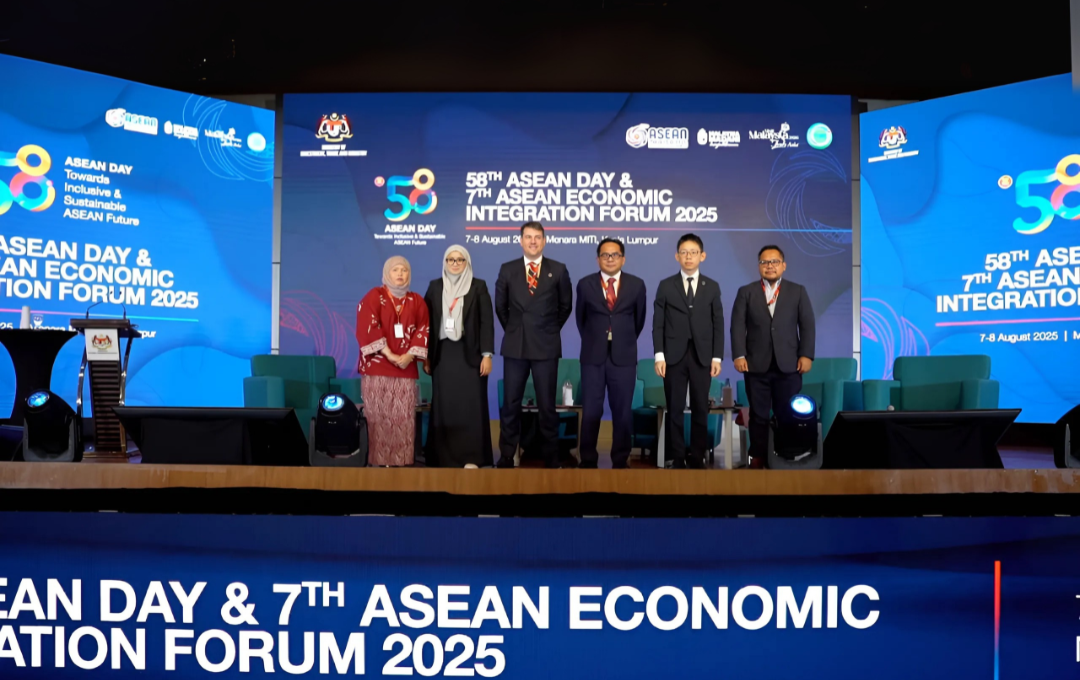
FIHRRST at the 7th ASEAN Economic Integration Forum: Advancing Human Rights in ASEAN’s Green Transition
The Foundation for International Human Rights Reporting Standards (FIHRRST), represented by Dr Unang Mulkhan, was honoured to participate in the 7th ASEAN Economic Integration Forum (AEIF), high-level event convening policy experts, industry leaders, and regional partners. The Forum was organised in collaboration with ERIA, IDE-JETRO, Kaneka (Malaysia), MPOB-UKM Endowment Chair, Bait Al-Amanah, DFAT, Yayasan Pok Rafeah (UKM), Global ASEAN, and the Society of Chartered Professional ESG Practitioners (SCPEP).
FIHRRST contributed to Policy Dialogue 2: “Turning the Tide: Powering ASEAN’s Green Shift through Just Transitions and Climate Resilience”, convened by Professor Dr Norasikin Ahmad Ludin of the Solar Energy Research Institute (UKM). The panel brought together diverse perspectives from across the region, with representatives from Kiu & co, Malaysian Green Technology and Climate Change Corporation (MGTC), Australian High Commission Singapore, and the Securities Commission Malaysia.
The session explored a pivotal question: How can ASEAN unlock the transformative potential of just transitions and climate resilience, not as isolated ambitions, but as a synergistic strategy for inclusive and sustainable development? This discussion is critical for a region that is both rich in biodiversity and highly vulnerable to climate risks and economic disruptions.
Representing FIHRRST, Dr Mulkhan highlighted the urgent need to address the reality that many vulnerable communities in ASEAN face the impacts of climate change without adequate protection or meaningful participation in decision-making. FIHRRST underscored that integrating human rights standards into national climate strategies and just transition pathways is essential to ensure fairness, equity, and resilience for all.
For FIHRRST, a truly just transition means more than shifting to clean energy, it requires recognising and amplifying community voices, ensuring equitable access to climate finance, safeguarding livelihoods, and protecting cultural heritage. The green shift must not only be environmentally sustainable but also socially just, leaving no one behind.